Sciatica PRO+ blog
The Two Halves of an Ingredient List
Four hundred milligrams, then one hundred and fifty, then a cliff.
Start here
Four hundred, one fifty, then a cliff
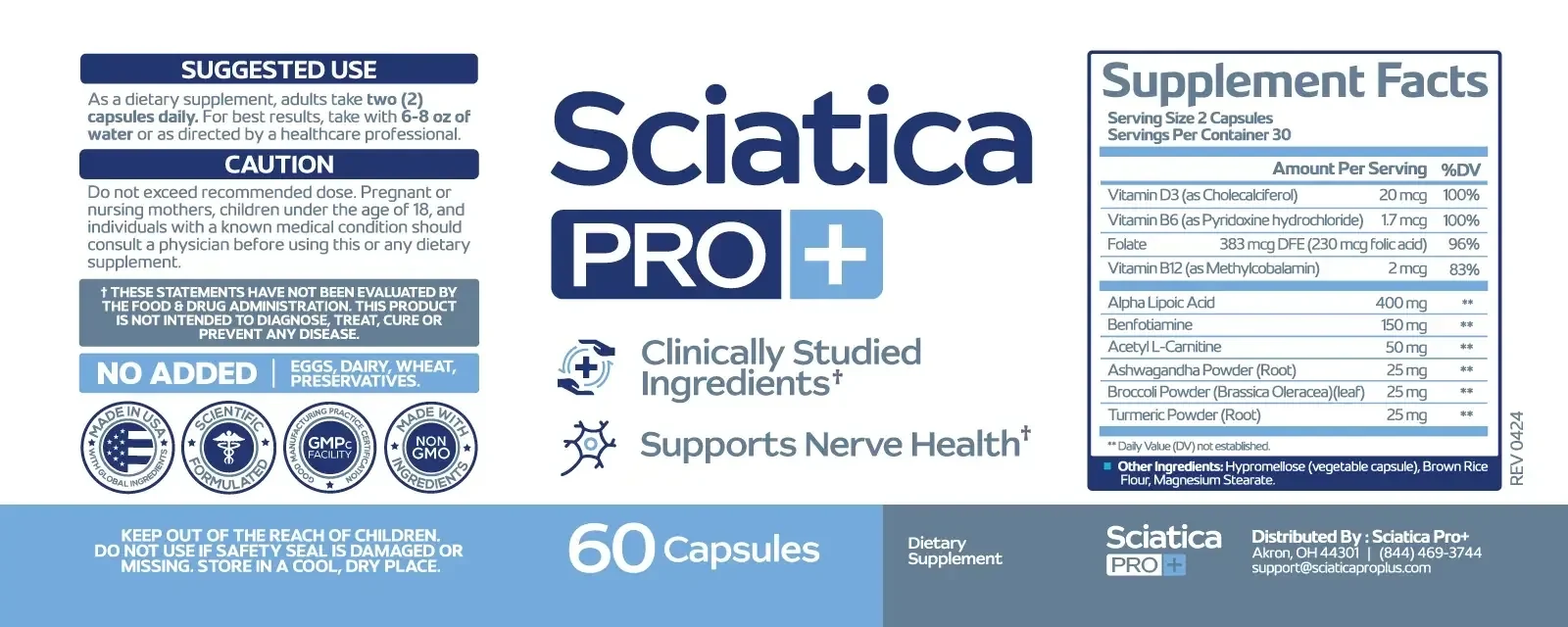
Read the six unstarred rows of this Supplement Facts panel in order and you will hear the shape of the formula before you have thought about a single ingredient. Alpha lipoic acid, 400 mg. Benfotiamine, 150 mg. Acetyl L-carnitine, 50 mg. Ashwagandha powder, 25 mg. Broccoli powder, 25 mg. Turmeric powder, 25 mg.
Four hundred, one hundred and fifty, then a cliff. The first two numbers are amounts of the kind you find in research. The last four are amounts of the kind you find in an ingredient list. Those three 25 mg rows come to 75 mg between them — less than a fifth of the alpha lipoic acid on its own.
This post is about that join: what it is, what the bottom half is doing there, and how to find the same join on a label you have never seen before.
The arithmetic
The split, drawn to scale
The dashed track is the 400 mg top row, held constant. The solid bar is each ingredient’s own amount on the same panel, at the label’s two-capsule serving.
Drawn to scale the point is hard to miss. Two bars carry the weight of the formula and four are slivers. That is arithmetic off a printed panel, and anybody can repeat it.
The two halves, stated plainly
The top half is alpha lipoic acid at 400 mg and benfotiamine at 150 mg: 550 mg of the 675 mg of unstarred actives in a two-capsule serving, or a shade over four fifths of the total. The bottom half is acetyl L-carnitine at 50 mg and three powders at 25 mg each: 125 mg between the four of them, spread across four names on the front of the box.
What each half costs to print
The top half is where the formula’s cost sits. The bottom half is where its vocabulary sits. Both are on the same panel, in the same units and the same type size, and nothing distinguishes them — which is why a reader has to do this themselves.
The purpose
What the second half is for
It is worth being precise about what the second half of an ingredient list is for, because the answer is not sinister and it is not a secret.
A longer list on the front of the box
Ingredients are a marketing asset before they are a dose. A formula with six named actives reads as more considered than one with two, and a card naming ashwagandha, broccoli and turmeric sounds broader than one saying alpha lipoic acid and benfotiamine. Adding a recognisable botanical at 25 mg buys a name on the front panel and a keyword in the listing, at a fraction of what it would cost to add it at a studied amount.
Why 25 mg is such a common number
Because it is the smallest amount that still looks like a decision. A row at 25 mg is deliberate, declarable and cheap, and it survives the one test most buyers run: whether the ingredient is present at all.
The word that does the work is “powder”
Three of these rows say powder, not extract. An extract concentrates whatever is thought to be doing the work and is usually standardised to a stated percentage of it. A powder is the dried plant, ground. Twenty-five milligrams of a dried root is twenty-five milligrams of a dried root, and the amount of any particular compound in it is not published on this label, because nothing requires it to be.
One row, read closely
Why 25 mg of turmeric is a culinary amount
Take the turmeric row as the clearest case, because it is the ingredient most readers already have an opinion about.
What the panel actually says
Turmeric Powder (Root), 25 mg. Not a curcumin extract, not standardised, not paired with anything to help absorption. Twenty-five milligrams of ground turmeric root is roughly what a cook shakes into a pan without measuring: a culinary quantity, sitting in a capsule.
What NCCIH says about the whole question
Before any argument about amounts, the National Center for Complementary and Integrative Health states its overall position in one sentence: “We don’t know enough to definitively conclude if turmeric or curcumin is beneficial for any health purposes.”
That is the ceiling on what anybody can claim for this ingredient at any amount. The studies that do exist use standardised curcumin extracts, often many hundreds of milligrams of them, and often with something added to aid absorption. Neither the standardisation nor the absorption aid appears anywhere on this label, and the amount is a fraction of the research quantities besides.
The same reading applies to the row above it
Ashwagandha at 25 mg is also a powder rather than a standardised extract, so its withanolide content is unknown. NCCIH describes the plant plainly — “Ashwagandha is an evergreen shrub found in parts of India, Africa, and the Middle East.” — and reports that some preparations may be effective for insomnia and stress. Nerve pain is not among the uses it summarises, and the preparations it does summarise are extracts at many times this amount. It also carries the one safety note on this panel worth repeating: “Although it is rare, there have been a number of cases that link liver injury to ashwagandha supplements.”
The method
How to spot the join on any label
The method transfers to any label that prints its amounts. It takes about a minute.
Rank the rows by weight and look for the drop
Ignore the names. Write the numbers in order and find the largest single gap between consecutive rows. On this panel it falls between 150 mg and 50 mg — a three-fold step in one line. That step is the join.
Add up everything below it
If the whole bottom half together weighs less than the top row on its own, the bottom half is a list rather than a dose. Here it is close: 125 mg of everything below the join, against 400 mg in the single row above it.
Check the units and the word beside each name
Milligrams and micrograms differ by a factor of a thousand and sit in the same column, so read the unit on every line. Then read the word: powder or extract, root or leaf, standardised or not. Those words change what an identical number means.
Then ask what the front of the box is selling
If the headline ingredient is in the bottom half, the packaging and the panel are telling different stories. Here they are not: the largest row is the one the category is built on, which is a point in this product’s favour.
Credit where due
The reason you can run this check here at all
Now the part that has to be said in the same piece, at the same volume, or the post is unfair.
You can only do any of this because the label let you
Every number above was read straight off the panel. Ten ingredients, ten individual amounts, no proprietary blend, a footnote whose marker matches the rows that carry it, and a serving size that is the same two capsules the directions ask for. Nothing had to be inferred, doubled, halved or guessed at.
Most of this category does not do that
The common alternative is a proprietary blend: several ingredients gathered under a name the company invented, one total weight printed, and the members listed in descending order by weight with no individual figures. On a label like that the split described here still exists — it simply cannot be seen. The ranking tells you which name is largest and nothing about how far apart the names are.
So the criticism and the credit are the same fact
This formula has a visible cliff in it because this label publishes enough to show one. A less transparent product with an identical formula would read as unimpeachable. It is a strange property of disclosure that it makes a product easier to criticise, and it is the reason a reader should reward it rather than punish it.
Closing
What the split does and does not prove
A split like this does not prove a product does nothing, and nothing here says it does. It shows where the formula’s weight actually is, so you can judge the bottle on its top half and treat its bottom half as what it is.
The honest version
Two rows here are real amounts: alpha lipoic acid at 400 mg and benfotiamine at 150 mg. If those two are what you want, this is a straightforward way to get them, with every other number on the panel printed beside them. Four rows are a longer ingredient list, and 25 mg of turmeric root powder is a pinch of a spice NCCIH says we do not know enough about at any amount. The ingredients page takes all ten rows one at a time, and the supplement facts page prints the whole wrap.
References
Sources
- National Center for Complementary and Integrative Health. Turmeric: Usefulness and Safety. www.nccih.nih.gov. Accessed September 30, 2026.
- National Center for Complementary and Integrative Health. Ashwagandha: Usefulness and Safety. www.nccih.nih.gov. Accessed September 30, 2026.
- National Center for Complementary and Integrative Health. Diabetes and Dietary Supplements: What You Need To Know. www.nccih.nih.gov. Accessed September 30, 2026.
- National Center for Complementary and Integrative Health. Using Dietary Supplements Wisely. www.nccih.nih.gov. Accessed September 30, 2026.
- NIH Office of Dietary Supplements. Dietary Supplements: What You Need to Know. ods.od.nih.gov. Accessed September 30, 2026.
Order Sciatica PRO+ from the official page
Vegetable capsules, 60 capsules a bottle, two a day with 6–8 oz of water, so thirty days a bottle. Ten ingredients with ten published amounts and no proprietary blend. 60 days from purchase to change your mind. The support line printed on the label is listed in the site footer.
Price shown at checkout · 60-day window from the date of purchase · ships from inside the US · every contact route is in the site footer
Next
Keep reading
All ten, with their amounts
What each row is, what it is doing here, and what the federal page says.
Read it →The caution panel, printed in full
What the label warns about, and what NCCIH reports for the botanical rows.
Read it →The category, from the top
What nerve supplements contain, and what no label of any kind may claim.
Read it →