Official product information
Sciatica PRO+ Ingredients List, Row by Row
Sciatica PRO+ has ten ingredients, each with its own printed amount and no proprietary blend.
The panel lists vitamin D3, B6, folate and B12, then alpha lipoic acid 400 mg, benfotiamine 150 mg, acetyl L-carnitine 50 mg, and ashwagandha, broccoli and turmeric powders at 25 mg each.
Next, see the whole label.
Quick answer
The Sciatica PRO+ panel declares ten ingredients and ten amounts, with no proprietary blend: vitamin D3, vitamin B6, folate and vitamin B12, then alpha lipoic acid 400 mg, benfotiamine 150 mg, acetyl L-carnitine 50 mg, and ashwagandha, broccoli and turmeric powders at 25 mg each. Two of those amounts are research-scale and four are not.
Turn the cards
Every Sciatica PRO+ ingredient, in the panel’s printed order
Front: what the row is and how much of it a two-capsule serving contains. Back: what the federal reference page says, quoted.
The Supplement Facts panel on the back of this bottle names ten ingredients and prints an amount beside every one of them. There is no proprietary blend and no total standing in for its parts. That single decision is what makes this page possible: every sentence below can be checked against a figure the manufacturer chose to publish rather than one we had to guess at.
The ten cards are in the panel’s printed order, starting with the four rows that carry a Daily Value. Turn a card over for what the federal page covering that ingredient reports — or, in three cases, for the plain statement that no federal consumer page covers it at all.
Card against label
The marketing card names six. The panel declares ten.
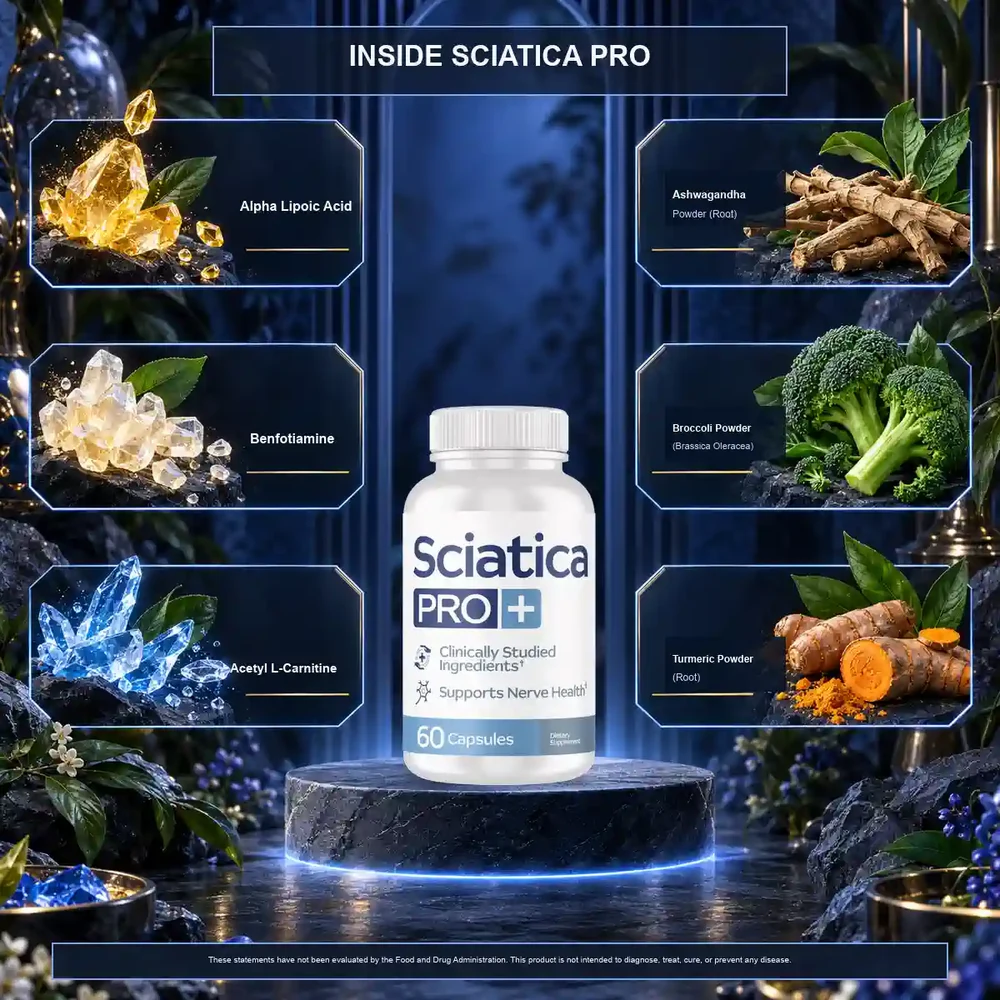
The “Inside Sciatica PRO” card names six: alpha lipoic acid, benfotiamine, acetyl L-carnitine, ashwagandha, broccoli powder and turmeric. The panel names ten — those six plus vitamin D3, vitamin B6, folate and vitamin B12. The four the card leaves out are the four with a published Daily Value, and on a nerve product they are the most interesting rows on the label.
Why the four missing rows are the interesting ones
A marketing card is allowed to be selective, and six botanical-sounding names photograph better than four vitamins. But the selection is backwards here. The six on the card are the rows nobody can check: benfotiamine and broccoli powder have no federal consumer page at all, and ashwagandha and turmeric are unstandardised powders, so even NCCIH’s summaries describe preparations this bottle does not contain. The four left off are the only rows with a published reference amount attached.
The panel
The ten amounts, with the reference figure beside each
| As the panel prints it | Per serving | %DV | Reference figure |
|---|---|---|---|
| Vitamin D3 (as Cholecalciferol) | 20 mcg | 100% | RDA 15 mcg; UL 100 mcg |
| Vitamin B6 (as Pyridoxine hydrochloride) | 1.7 mg | 100% | RDA 1.3 mg; UL 100 mg |
| Folate | 383 mcg DFE (230 mcg folic acid) | 96% | RDA 400 mcg DFE; UL 1,000 mcg folic acid |
| Vitamin B12 (as Methylcobalamin) | 2 mcg | 83% | RDA 2.4 mcg; no UL set |
| Alpha Lipoic Acid | 400 mg | ‡ | Studied in diabetic neuropathy |
| Benfotiamine | 150 mg | ‡ | No federal consumer page |
| Acetyl L-Carnitine | 50 mg | ‡ | Research in this area uses grams |
| Ashwagandha Powder (Root) | 25 mg | ‡ | Unstandardised powder |
| Broccoli Powder (Brassica Oleracea)(leaf) | 25 mg | ‡ | No federal page |
| Turmeric Powder (Root) | 25 mg | ‡ | Powder, not standardised extract |
The first three columns are transcribed from the wrap label. The fourth is the published reference amount, or the plain statement that no federal page covers that row. ‡ Daily Value (DV) not established.
The six unstarred rows come to 675 mg of named actives a serving, and because nothing is pooled you can see how that total is distributed. Alpha lipoic acid is 400 of those 675 milligrams, benfotiamine another 150, and the remaining four rows share 125 between them.
The dose split
Two halves: the rows doing work, and the rows lengthening the list
Because every amount is printed, the formula splits cleanly into two halves. The top of the panel is serious. Alpha lipoic acid at 400 mg is within sight of the amounts used in the neuropathy research, and benfotiamine at 150 mg is a real dose of a real compound. The bottom of the panel is not. Acetyl L-carnitine appears at 50 mg where studies use grams. Ashwagandha appears at 25 mg where NCCIH’s summarised research uses many times that. Turmeric appears at 25 mg of powder — not an extract, not standardised — which carries a trace of curcumin. Broccoli powder at 25 mg is a quarter of a gram of vegetable. Those four lengthen the ingredient list more than they change what is in the capsule.
The four vitamin rows against their published reference amounts
The starred rows cannot be read this way: no Daily Value is established for any of them. The four vitamin rows can. In the bars below, the dashed bar is the federal reference figure and the solid bar is what a two-capsule serving contains.
Against the amount an adult is told to get
The folate bar is a rounding difference and nothing more. The B12 bar is the finding on this page: on a product sold for nerve health, the one vitamin whose deficiency ODS describes in terms of numb and tingling hands and feet is the single row that does not reach a day’s requirement — and it has no upper limit, so nothing in the safety literature pushed it down there.
Against the ceiling, where one is published
An upper limit counts every source, not just this bottle, so the useful reading is not “this product is under the limit” but “this product spends two per cent of the B6 headroom, and everything else on the shelf draws on the same allowance”. The full arithmetic is on the how to take it page.
The honest section
Powder, not extract: three rows where one word does the work
Three of the ten rows carry a word that changes what they mean, and all three words are printed on the label rather than left off it. Ashwagandha is declared as powder (root), turmeric as powder (root), broccoli as powder and specifically as leaf. None is described as an extract, none carries a standardisation figure, and none names the compound it is usually bought for.
What a standardisation figure would tell you
A standardised extract states how much of the active compound it holds: so many milligrams of withanolides, so many per cent curcuminoids, so much sulforaphane. Without that figure, 25 mg of turmeric powder and 25 mg of a concentrated curcumin extract are the same number describing two very different things, and only one of them resembles what the research used. Honestly placed rather than condemned: 25 mg of culinary turmeric powder is a pinch of a spice, and an amount too small to raise a safety question is usually too small to raise a benefit question.
What we would ask the distributor
Two questions. Why is vitamin B12 at 2 mcg on a nerve product, when the RDA is 2.4 mcg and there is no upper limit to work around? And are the ashwagandha, turmeric and broccoli rows standardised to anything? The label prints a support line and an email for questions like these (both are in the site footer), which is more than most products here give you to ask with.
Questions
Sciatica PRO+ FAQ: ingredients questions
Is there a proprietary blend?
No. Ten ingredients, ten individual amounts. That is the best thing about this label and it is the reason the rest of this site can be as specific as it is.
Which ingredients are actually at a useful amount?
Two. Alpha lipoic acid at 400 mg and benfotiamine at 150 mg. Acetyl L-carnitine at 50 mg is a fraction of what studies use, and ashwagandha, broccoli and turmeric at 25 mg each are smaller still.
Why is turmeric only 25 mg?
We do not know, and the wording matters: the panel says turmeric <em>powder</em>, not a standardised curcumin extract. NCCIH notes that oral curcumin products vary in how much curcumin they contain. 25 mg of plain root powder is a culinary amount.
Is it vegetarian?
Yes, on the label’s own evidence. The other-ingredients line reads “Hypromellose (vegetable capsule), Brown Rice Flour, Magnesium Stearate” and nothing on the panel is animal-derived.
References
Sources for this page
- National Center for Complementary and Integrative Health. Diabetes and Dietary Supplements: What You Need To Know. www.nccih.nih.gov. Accessed September 30, 2026.
- National Center for Complementary and Integrative Health. Ashwagandha: Usefulness and Safety. www.nccih.nih.gov. Accessed September 30, 2026.
- National Center for Complementary and Integrative Health. Turmeric: Usefulness and Safety. www.nccih.nih.gov. Accessed September 30, 2026.
- NIH Office of Dietary Supplements. Vitamin B12. ods.od.nih.gov. Accessed September 30, 2026.
- NIH Office of Dietary Supplements. Folate. ods.od.nih.gov. Accessed September 30, 2026.
Next
Keep reading
The whole label, panel by panel
Every printed line on the wrap, including the ones nobody quotes.
Read it →What the research actually covers
Diabetic neuropathy, mechanical compression, and why the gap matters.
Read it →Claimed, and evidenced
The two claims on the bottle against what the federal pages support.
Read it →Order Sciatica PRO+ from the official page
60 capsules a bottle in a hypromellose vegetable capsule, ten named ingredients with ten published amounts, and 60 days from purchase to change your mind. Price is shown at checkout.
Price shown at checkout · 60-day window from the date of purchase · ships from inside the US · every contact route is in the site footer