Official product information
How Does Sciatica PRO+ Work? What Each Part Does
Sciatica PRO+ is a nerve-support formula led by alpha lipoic acid, its best-researched ingredient.
Most research on alpha lipoic acid looked at diabetic neuropathy, nerve damage from long-term high blood sugar, while sciatica comes from pressure on a nerve root.
Next, see all ten ingredients.
Quick answer
The best-evidenced ingredient in Sciatica PRO+ is alpha lipoic acid, and the research on it is about diabetic neuropathy — nerve damage from long-term high blood sugar. NCCIH calls even that evidence inconsistent. Sciatica is mechanical compression of a nerve root, and no trial of this formula exists in either condition.
The mechanism
What the ingredients are proposed to do
Written as proposals, because that is what they are until somebody runs a trial.
There are two honest ways to answer the question in this page’s title, and the difference between them is the whole subject. The first is mechanistic: what each ingredient is understood to do inside a cell, and why a formulator would put it in a nerve product. The second is evidential: what was actually tested, in whom, and what the result was. Most supplement pages give you the first and let you assume the second. This page gives both, in that order, and keeps them apart.
The label itself claims something much smaller than either: “Supports Nerve Health”, with a dagger tying it to the FDA disclaimer on the same bottle. That is a correctly written structure/function claim. It is not a claim that this product does anything about sciatica, and the manufacturer has not made one.
What each row is proposed to do
Alpha lipoic acid is an antioxidant the body makes in small amounts. The argument for it in nerve formulas is oxidative stress: tissue damaged by a metabolic process is exposed to reactive compounds, and an antioxidant is proposed to reduce that exposure. Benfotiamine is a fat-soluble derivative of thiamine, vitamin B1, chosen because it is absorbed differently from ordinary thiamine, and thiamine is required by the enzymes that run glucose metabolism. Acetyl L-carnitine is involved in moving fatty acids into mitochondria, and appears here on a cellular-energy argument.
The four vitamins have the clearest and least speculative mechanisms of the ten. Vitamin B12 is required to build and maintain the myelin sheath around a nerve; ODS puts it as “Vitamin B12 helps keep your body’s blood and nerve cells healthy.” Vitamin B6 is a cofactor in more than a hundred enzyme reactions, folate is needed to make DNA and for cells to divide, and vitamin D has a role ODS states directly: “Your muscles need it to move, and your nerves need it to carry messages between your brain and your body.” The three botanical powders are included on general antioxidant arguments, at amounts covered on the ingredients page.
Every sentence in those two paragraphs is a proposal about a mechanism. Not one of them is a finding about a person, and that distinction is where this page turns.
The spine of this page
The evidence is for a different condition
Two conditions, two mechanisms, and a body of research that belongs to only one of them.
Here is the part that matters most, and it is not about dose. The best-evidenced ingredient in this bottle is alpha lipoic acid, and the research on it is about diabetic neuropathy — nerve damage caused by long-term high blood sugar. NCCIH’s summary is honest about how mixed even that is: a 2022 review found “inconsistent findings”, with three studies showing symptom improvement and five not, while another 2022 review concluded alpha lipoic acid “might help reduce pain in people with diabetic neuropathy”. Sciatica is a different problem entirely. It is compression or irritation of one large nerve, usually by a disk or a narrowed canal. An antioxidant studied in metabolic nerve damage is not evidence for a mechanical one, and nobody — including this label — claims that it is.
What MedlinePlus says sciatica is
“Sciatica is a symptom of a problem with the sciatic nerve, the largest nerve in the body.”
MedlinePlus, U.S. National Library of Medicine
On where it comes from: “Common causes include a ruptured intervertebral disk, spinal stenosis, and pelvic injuries. In many cases no cause can be found.” On what is done about it: “Treatment may include exercises, medicines, and surgery. Sometimes sciatica goes away on its own.” Read those three sentences together and the shape of the problem is structural. Something is pressing on a nerve, and the interventions listed are the ones that change the mechanics, reduce the inflammation around the compression, or remove the cause surgically.
What NINDS says neuropathy is
“Peripheral neuropathy refers to the many conditions that involve damage to the peripheral nervous system.”
National Institute of Neurological Disorders and Stroke
NINDS also names the dominant cause in this country: “Diabetes is the leading cause of peripheral neuropathy in the U.S.” That is the condition the alpha lipoic acid research is about. High blood sugar over years damages nerve fibres chemically, and an antioxidant has a plausible route into that process. It has no route into a disk pressing on a nerve root.
Even inside the condition it was studied in, NCCIH reports the literature as unsettled. A 2022 review found “A 2022 review found inconsistent findings: three studies showed symptom improvements while five did not.” A second concluded that “Alpha-lipoic acid might help reduce pain in people with diabetic neuropathy.” Those are not contradictory; they are what an honest reading of a mixed evidence base looks like. So the chain a buyer is invited to follow has three links and two of them do not hold: alpha lipoic acid has mixed evidence in diabetic neuropathy, diabetic neuropathy is not sciatica, and this product has not been tested in either.
Reading the front panel
“Clinically studied ingredients” is not a clinically studied product
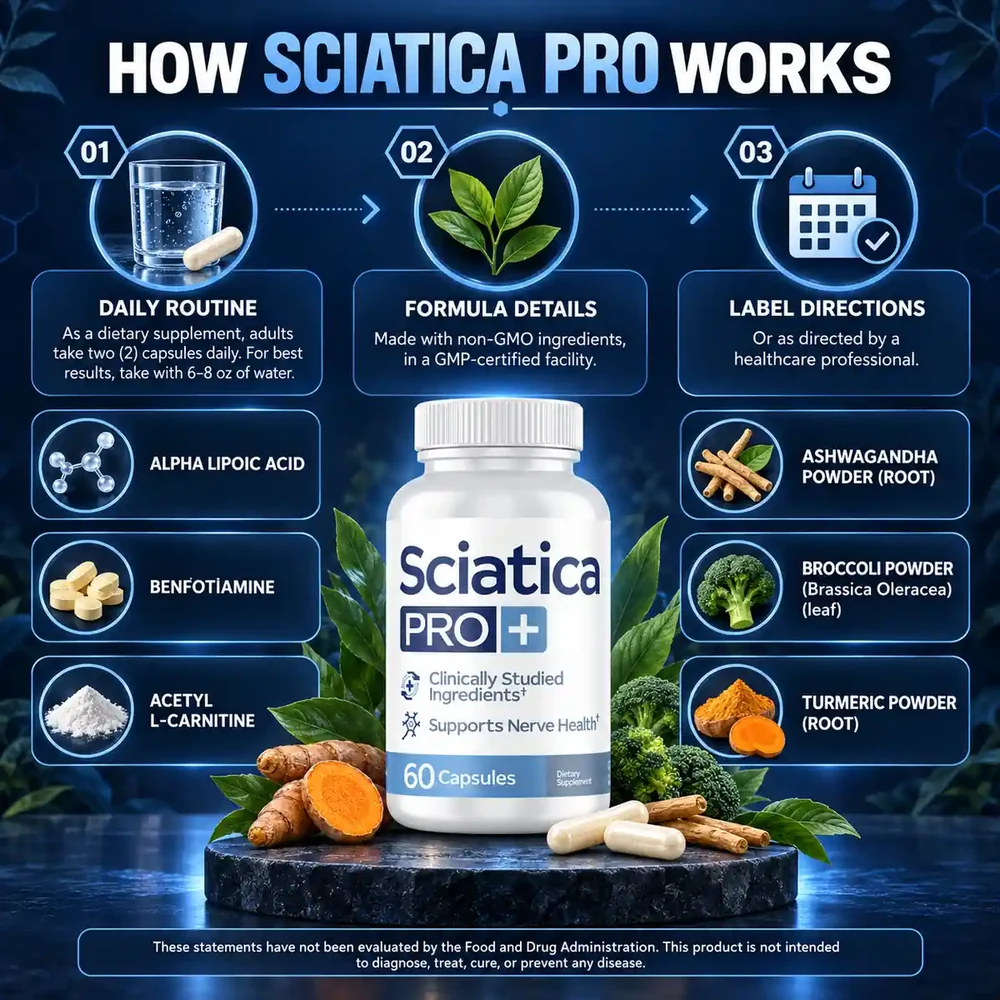
The seller’s three-step panel reads Two capsules daily with 6-8 oz of water; Four B-group and D vitamins plus six named actives; and Thirty servings a bottle. Dietary supplement.. Notice what it does not say. There is no absorption story, no diagram of a nerve, no claim about a pathway and no promise about a week. It describes a serving, a formula and a bottle size, and all three descriptions check out against the panel.
The claim on the front, read exactly
The front panel also reads “Clinically Studied Ingredients†”, and the dagger again resolves to the FDA disclaimer. Read the words exactly: ingredients, not product. Alpha lipoic acid has been studied. Benfotiamine has been studied. Acetyl L-carnitine has been studied. This combination, at these amounts, has not — no trial of this formula was supplied to us and none is published anywhere we could find. The claim on the bottle is literally true and does less work than it appears to.
The gap between “clinically studied ingredients” and a clinically studied product is not a technicality. A formula is a set of interactions rather than a sum of parts: amounts change, absorption changes, and the only way to know what a combination does is to test that combination. Four of the ingredients here sit at amounts far below anything studied even individually, so the phrase covers rather less of the bottle than it appears to. What it does cover, it covers truthfully — alpha lipoic acid has genuinely been studied, at amounts within sight of the 400 mg here.
The missing trial
What a real answer would require
If this formula were going to be tested properly, the trial would have to answer three questions nothing currently published can. It would need people with sciatica rather than with diabetic neuropathy, because the two have different causes and different natural histories. It would need a control group, because MedlinePlus notes that sciatica “sometimes goes away on its own”, which makes any uncontrolled improvement uninterpretable. And it would need to test this combination at these amounts, because a result for 400 mg of alpha lipoic acid alone tells you nothing about 400 mg alongside nine other things.
What the four vitamin rows could plausibly do
There is one route by which a product like this could matter to a person with nerve symptoms, and it is not the route the name suggests. If numbness comes from a vitamin B12 deficiency — a real cause, which ODS describes in exactly those terms — then correcting the deficiency is the thing that helps. NINDS names the two best-known vitamin-related causes plainly: “Vitamin B12 deficiency and excess vitamin B6 are the best-known vitamin-related causes.” But this bottle supplies 2 mcg of B12 against a 2.4 mcg RDA, which is not a correcting dose, and a blood test rather than a capsule is what would tell you whether a deficiency is the problem in the first place.
What can be said, and what cannot
Can be said: this bottle supplies 400 mg of alpha lipoic acid and 150 mg of benfotiamine, both at amounts a researcher would recognise, plus a full Daily Value of vitamin D and vitamin B6. Cannot be said: that any of that addresses a compressed nerve root, that research in diabetic neuropathy transfers to sciatica, or that this combination has been tested in anybody. The label claims none of it either.
NCCIH publishes a general rule for exactly this situation, written about diabetes and applying to anything a supplement is bought instead of: “It’s very important not to replace medical treatment for diabetes with an unproven health product or practice.” If leg pain is new, if it is worsening, if there is weakness, or if there is any change in bladder or bowel control, that is a same-day medical question and no reading on this site should delay it.
Questions
Sciatica PRO+ FAQ: how it works questions
Does it treat sciatica?
Nothing on the label claims that, and a supplement may not. MedlinePlus describes sciatica as a symptom of a problem with the sciatic nerve, commonly caused by a ruptured disk, spinal stenosis or a pelvic injury, and treated with exercises, medicines and surgery. The product is named after the condition; its printed claims are not about it.
What does “clinically studied ingredients” mean?
That the ingredients have been studied, not that this product has. No trial of this formula was supplied to us and none is published anywhere we could find. The wording is literally accurate and narrower than it first appears.
What is the difference between sciatica and neuropathy?
Sciatica is a symptom of a mechanical problem with one specific large nerve. Peripheral neuropathy is NINDS’s term for “the many conditions that involve damage to the peripheral nervous system”, most often caused in the US by diabetes. Different causes, different treatments, different research.
Does alpha lipoic acid work?
NCCIH’s summary is mixed and worth reading in full. A 2022 review found “inconsistent findings” — three studies showed symptom improvement, five did not — while another 2022 review concluded it “might help reduce pain in people with diabetic neuropathy”. On blood sugar it was no better than placebo.
References
Sources for this page
- MedlinePlus, U.S. National Library of Medicine. Sciatica. medlineplus.gov. Accessed September 30, 2026.
- National Institute of Neurological Disorders and Stroke, NIH. Peripheral Neuropathy. www.ninds.nih.gov. Accessed September 30, 2026.
- National Center for Complementary and Integrative Health. Diabetes and Dietary Supplements: What You Need To Know. www.nccih.nih.gov. Accessed September 30, 2026.
- NIH Office of Dietary Supplements. Vitamin B12. ods.od.nih.gov. Accessed September 30, 2026.
- National Center for Complementary and Integrative Health. Using Dietary Supplements Wisely. www.nccih.nih.gov. Accessed September 30, 2026.
Next
Keep reading
Order Sciatica PRO+ from the official page
Alpha lipoic acid 400 mg and benfotiamine 150 mg, both published, in a vegetable capsule. 60 capsules a bottle, thirty days at two a day, and 60 days from purchase to change your mind.
Price shown at checkout · 60-day window from the date of purchase · ships from inside the US · every contact route is in the site footer